


Memorial stone commemorating the Polish scout troop in pre-war Szczecin
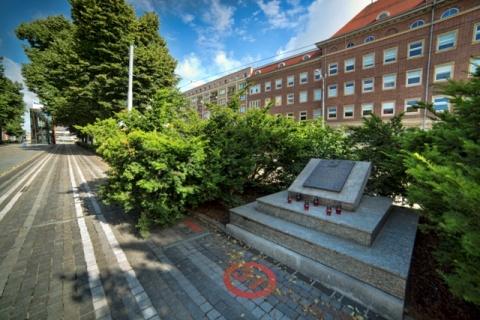
In pre-war Szczecin there existed a small Polish community. Its former presence can be recognized thanks to the Rodło symbol – the characteristic zigzag line represents the course of the River Vistula, with the location of Kraków marked. Rodło remains the emblem of the Union of Poles in Germany and was introduced in 1933, when the German authorities banned the use of the coat of arms of the Republic of Poland. The symbol appears on a plaque commemorating the establishment of the first Polish scout troop in Szczecin in 1934.
The plaque is mounted on a pedestal on which, in 1793, a white-marble monument to King Frederick the Great once stood. The monument was designed by Johann Gottfried Schadow, the creator of the Quadriga of Victory on Berlin’s Brandenburg Gate. Despite the mixed feelings the people of Szczecin had toward the Prussian order introduced by him, the “Old Fritz” was to be protected from the destructive effects of weather. The effort proved successful, and after many twists and turns the monument can still be admired today — in the courtyard of the Palace of the Pomeranian Estates.
The empty pedestal now commemorates the Polish scout troop “Gryf,” founded in Szczecin in 1934 by Maksymilian Golisz, as well as the cub scout group “Wiewiórki,” established a year later on the initiative of Aleksander Omieczyński. Both were teachers and activists of the Union of Poles in Germany, and also cooperated with Polish military intelligence. They were deeply involved in promoting Polish culture — Golisz by founding Polish schools and working within the Union’s structures, and Omieczyński by organizing teaching centers, libraries and distributing Polish press.
At the beginning of the war, Maksymilian Golisz was arrested, imprisoned in concentration camps, and later drafted into the German army. He was arrested again in October 1942, this time on charges of treason, and executed by beheading in April of the following year. Aleksander Omieczyński had already been arrested in June 1939, and his death sentence was carried out in September 1941 in Szczecin. At the time of their deaths, they were 34 and 30 years old respectively.